
Prop Firm Drawdown Rules Compared: Topstep vs Apex
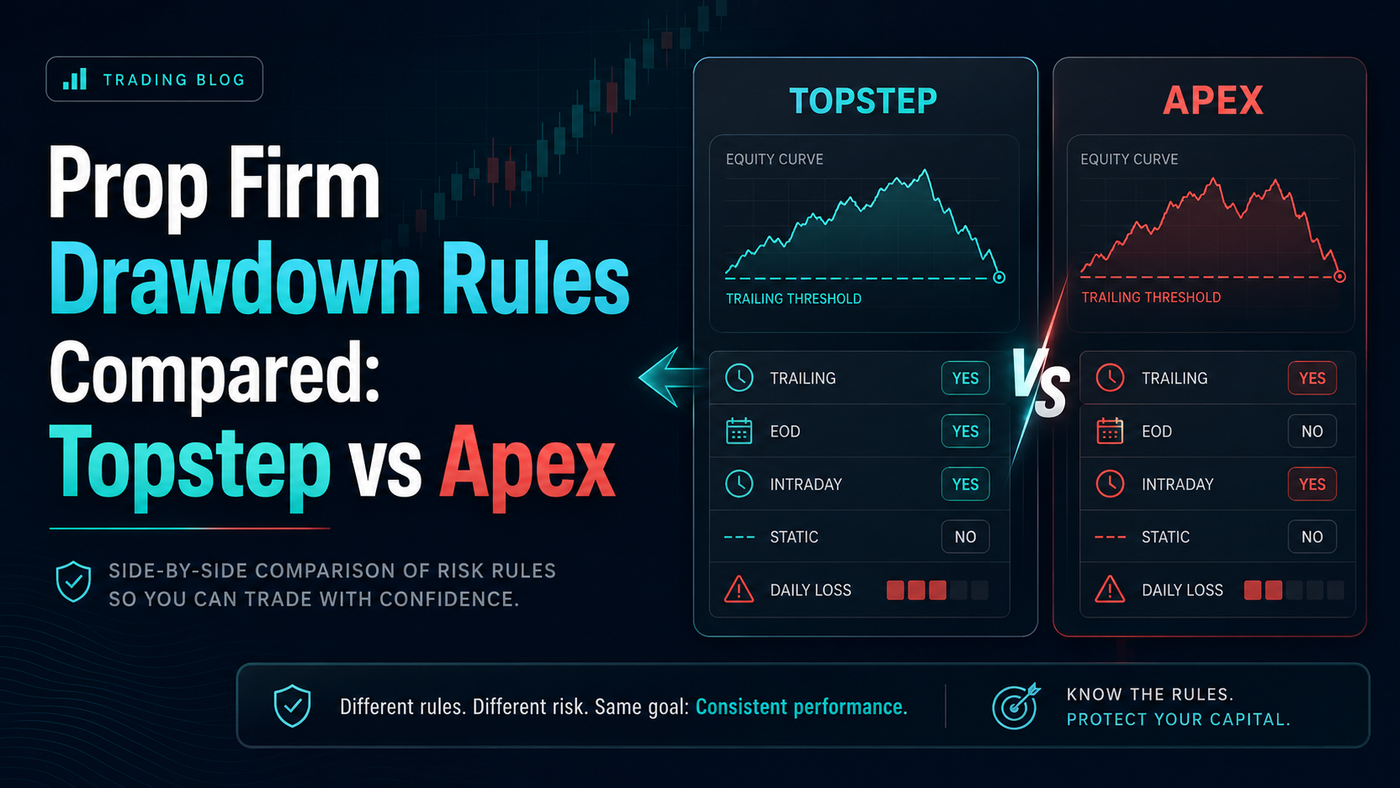
Prop Firm Drawdown Rules Compared: Topstep vs Apex
Last reviewed: July 2026
Prop firm drawdown rules are far more important than the headline account size, yet they are often the last thing traders properly understand before buying an evaluation.
A $50,000 account with $2,000 of permitted drawdown does not give you $50,000 to trade.
From a risk perspective, the $2,000 is the number that matters.
The confusing part is that not every firm calculates that number in the same way. Some drawdown limits trail your balance at the end of the trading day. Others can follow unrealised profit while a position is still open. Some eventually stop trailing, while others combine an overall drawdown limit with a separate daily loss rule.
This is where two accounts with similar headline numbers can feel completely different to trade.
The table below compares the main drawdown structures currently offered by Topstep and Apex. Both firms have multiple account products, so always check the exact product rather than assuming every account from the same firm works identically.
Drawdown comparison at a glance
| Account type | Drawdown calculation | Moves with unrealised profit? | When does it update? | Daily loss rule |
|---|---|---|---|---|
| Topstep standard Trading Combine | End-of-day trailing Maximum Loss Limit | No | After the trading day | Optional on standard products |
| Topstep Express Funded Account | Trailing Maximum Loss Limit until it reaches $0 | No intraday trailing from open equity | Based on account balance rules | Optional on standard XFA products |
| Apex EOD Drawdown | End-of-day trailing threshold | No | At market close | Yes on applicable new EOD products |
| Apex Intraday Trailing | Real-time trailing threshold | Yes | Continuously intraday | No DLL during the Intraday Evaluation; PA rules vary |
| Apex Legacy Static | Fixed drawdown | No | Never trails | Legacy product rules apply |
Topstep's standard Maximum Loss Limit trails based on the end-of-day balance rather than an intraday unrealised peak. For example, Topstep currently states that its standard $50K Trading Combine starts with a $2,000 Maximum Loss Limit. In an Express Funded Account, the Maximum Loss Limit trails upward until it reaches $0, at which point it stops moving.
Apex now offers both EOD and Intraday Trailing account structures. Its EOD threshold is calculated from the closing balance and remains fixed through the following session, whereas its Intraday Trailing threshold can move upward in real time based on the highest account balance reached, including unrealised P&L.
That difference matters more than it might initially sound.
Why intraday trailing drawdown catches traders out
Imagine you have an account with a $2,000 intraday trailing drawdown.
You open a trade and it goes $1,000 into profit.
You decide to hold for a larger target.
The trade then comes all the way back and you close for $100.
From a normal P&L perspective, you made $100.
But on an account where the drawdown followed your unrealised peak, your risk threshold may have moved substantially higher while the trade was in profit.
You effectively gave back much more account room than the realised P&L suggests.
This is why some trading styles are naturally harder to run under an intraday trailing model.
If you regularly let trades run deep into open profit and give them significant room to pull back, you need to understand exactly how the threshold is being calculated.
Apex's current Intraday Trailing products explicitly calculate the threshold from the account's peak balance in real time. The firm states that the threshold moves upward immediately when a new peak is reached and does not subsequently move back down.
That is completely different from an end-of-day system.
Ten losses, not two percent
Dollar figures can make prop accounts sound bigger than they really are.
When I am trading NQ, I find it more useful to think about the usable drawdown in relation to my actual trade risk.
Suppose I have $2,000 of account room and I normally risk $200 per trade.
Ignoring commissions and slippage for simplicity, I have roughly ten full-risk losses available from the starting point.
That does not mean I should happily take ten losses.
It means I can immediately see why risking $800 because I particularly like one setup is a terrible idea.
One losing trade has just consumed the equivalent of four normal losses.
This becomes even more important when copying trades across several prop accounts. The headline numbers become large very quickly, but the underlying risk is still based on the drawdown available in each individual account.
Topstep drawdown
On Topstep's standard products, the Maximum Loss Limit uses an end-of-day trailing calculation. It does not chase every unrealised intraday high.
Using the current $50K Trading Combine as an example, the starting Maximum Loss Limit is $2,000 below the initial account balance. As profitable end-of-day balances increase, the loss limit moves upward and does not subsequently move back down.
On the standard $50K Express Funded Account, the account itself starts with a $0 balance and the Maximum Loss Limit begins at -$2,000. Once the trader builds the balance to $2,000, the Maximum Loss Limit reaches $0 and stops trailing. Topstep also states that after the first payout the XFA Maximum Loss Limit is set to $0 regardless of where it had previously been.
One thing worth noting is that Topstep's product range has changed considerably, including optional Daily Loss Limits on standard Trading Combines and Express Funded Accounts and newer experimental products with different risk structures. You therefore need to check the exact account being purchased rather than relying on an old comparison article.
Apex drawdown
Apex is slightly more complicated because its current product range includes both EOD and Intraday Trailing options, while older Legacy accounts have their own rules.
The EOD model is easier to understand for traders used to a conventional trailing drawdown. The threshold is recalculated at the end of the day based on the closing account balance. It can still be breached during the following session, but it does not follow every intraday open-profit peak.
The Intraday Trailing model is more aggressive.
On a current Apex $50K Intraday Performance Account, the maximum intraday trailing drawdown is listed as $2,500. The account balance, including unrealised P&L, must not touch or fall below the active trailing threshold.
Apex's newer EOD accounts also use a separate Daily Loss Limit. Reaching the DLL pauses trading for the rest of the session rather than automatically closing the Performance Account, whereas breaching the overall EOD drawdown threshold fails the account. Apex currently lists the starting DLL on its $50K EOD evaluation at $1,000.
That distinction is worth understanding.
A daily limit controls one bad session.
The overall drawdown controls the life of the account.
They are not the same thing.
Which drawdown model is better?
There is no universally better model, but there are definitely models that suit particular trading styles better.
Personally, I find end-of-day trailing easier to manage because a good open trade does not immediately reduce your future breathing room simply because it temporarily reached a large unrealised profit.
A trader who takes quick scalps and rarely gives back open profit might be perfectly comfortable with intraday trailing drawdown.
A trader who lets runners develop and regularly sees significant fluctuations in open P&L needs to be much more careful.
The mistake is choosing an account purely because the profit target looks achievable or because there is a large discount available.
Before buying any prop evaluation, I would want to know:
How much actual drawdown do I have?
Does it trail?
Does it include unrealised profit?
When does it update?
Does it eventually stop trailing?
Is there also a daily loss limit?
What happens to the drawdown after a payout?
Those answers matter far more to me than whether the account says $50K, $100K or $150K at the top of the dashboard.
Build your own limit inside the firm's limit
The other thing I would strongly recommend is not using the prop firm's drawdown as your personal stop.
If the firm gives you $2,000 of room, that does not mean your plan should be to keep trading until you have lost $1,999.
Your own limits should sit well inside theirs.
That might mean a maximum amount you are prepared to lose per trade, a daily loss limit and a limit on how many failed ideas you will take before stopping.
This is where I use my trading journal alongside the rules of the funded account.
The firm tells me the maximum loss they will tolerate.
My journal should tell me the maximum loss that actually makes sense for my strategy.
Those are two very different numbers.
Wave Rider fits into the same process from the other side. The journal tells me what I have been doing. Wave Rider helps me filter what I am about to do by requiring structure and trend conditions rather than giving me another excuse to trade.
For me, that is the real challenge with prop accounts.
Passing them is not particularly useful if the way you trade gives you no realistic chance of keeping them.
Understanding the drawdown rules is the boring part.
Unfortunately, the boring parts are normally the ones that keep the account alive.
Prop firm rules change regularly. The comparisons above were reviewed against official Topstep and Apex information in July 2026. Always check the current rules for the exact account type you are considering before purchasing or trading it.
Want this read on your own chart?
Wave Rider marks the structure, the EMA stack and the levels automatically — live, on any market you trade.
See Wave Rider → Or start with the free onesCharting and analysis only — nothing here is financial advice. Trading involves substantial risk of loss.