
How to Use a Deskpad Journal to Stop Emotional Trading
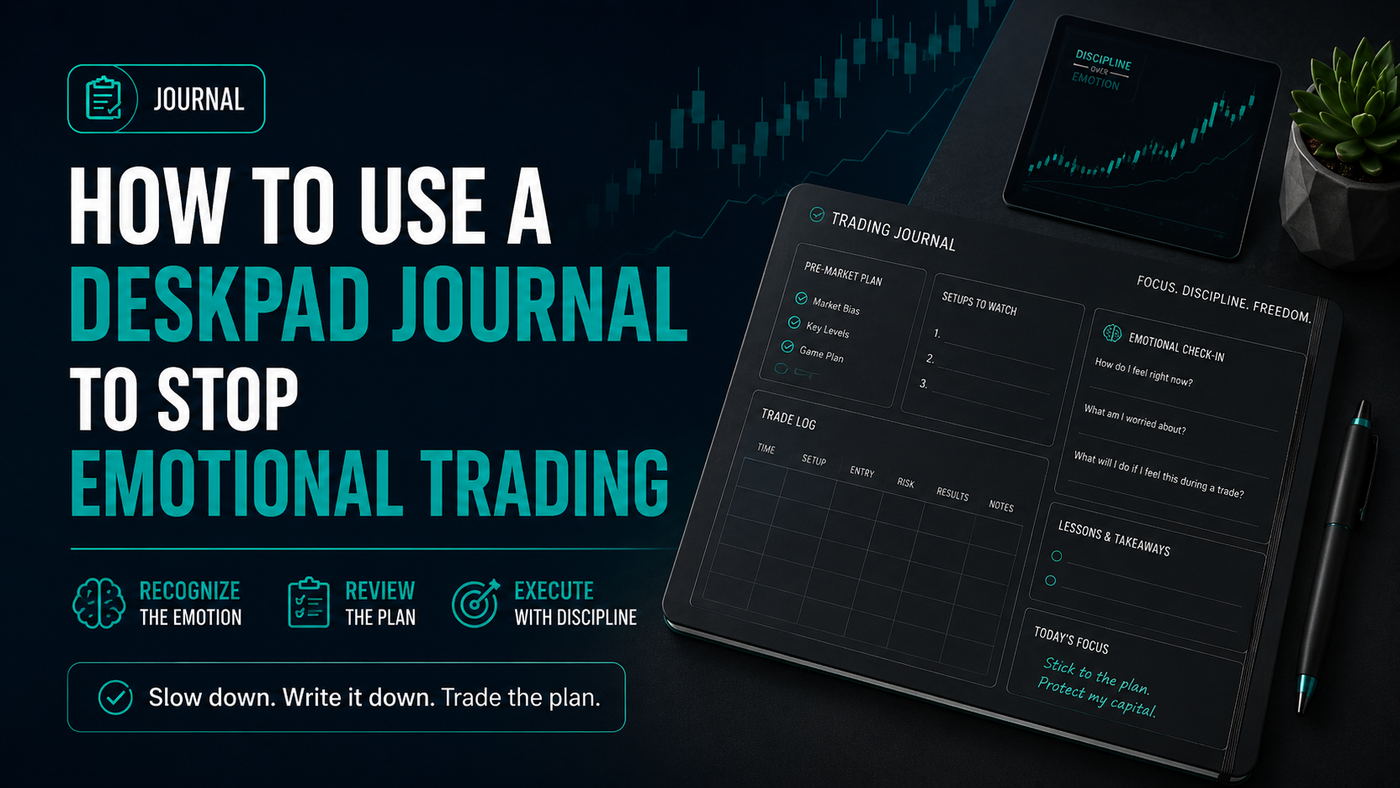
The Psychological Circuit-Breaker: Using a Deskpad to Stop Emotional Trading
Every trader knows the feeling. A sudden spike in volatility, a missed entry, or a stinging loss. In an instant, the "Professional Trader" leaves the room, and the "Emotional Gambler" takes over.
This is the moment of the Emotional Trade. It’s the revenge trade to "get it back," the FOMO entry because the price is mooning, or the refusal to move a stop-loss because of pride.
The problem is that these decisions happen in the amygdala—the primitive, emotional part of the brain. By the time your logical mind catches up, the trade is already live and your capital is at risk.
The "Digital Fog" of Emotional Trading
When you use a digital journal or a spreadsheet, you are operating within the same environment that triggers your stress. The screens, the alerts, the flashing numbers—they all contribute to a state of "high arousal."
Trying to maintain discipline on a screen is like trying to put out a fire with a squirt bottle. The digital interface is too fluid; it allows you to ignore your rules, delete your mistakes, and lie to yourself about why you entered a trade.
The Power of the Physical Circuit-Breaker
A physical deskpad acts as a cognitive "circuit-breaker." When you are forced to pick up a pen and physically write down your trade, you move the process from the emotional amygdala to the logical prefrontal cortex.
1. The Friction Effect
Digital is too easy. Clicking a button takes a millisecond. Writing a trade takes seconds. That tiny bit of friction is exactly what you need. It creates a mandatory gap between the impulse and the action. If you can't bring yourself to write the trade down, you probably shouldn't be taking the trade.
2. The Visual Anchor
A digital tab can be minimised. A spreadsheet can be closed. But an A3 deskpad is an omnipresent reminder of your rules. When your deskpad is open in front of you, your strategy is staring you in the face. It is much harder to ignore a written rule when it is physically occupying your workspace.
3. The Weight of Accountability
There is a profound difference between typing "I'm feeling impulsive" and writing it in ink. Ink is permanent. It doesn't allow for the "edit" that happens in our minds after a loss. Facing your emotional failures in a physical log is the only way to develop the self-awareness required to stop them from happening again.
───
🛑 Stop the Revenge Trade Before it Starts.
You cannot out-think your emotions when you're in the heat of a session. You need a system that forces you to be professional.
The DMC Trading Journal isn't just a log—it's a psychological tool designed to break the cycle of emotional trading. By moving your plan from the screen to the desk, you reclaim control over your capital.
The Discipline Edge:
✓ Physical Accountability: No more "forgetting" the rules.
✓ Cognitive Slowdown: Bridge the gap between impulse and execution.
✓ Permanent Record: Face your mistakes and evolve your edge.
Get Your Emotional Circuit-Breaker - The A3 Deskpad Journal
Stop gambling. Start journaling. Protect your capital.
Want this read on your own chart?
Wave Rider marks the structure, the EMA stack and the levels automatically — live, on any market you trade.
See Wave Rider → Or start with the free onesCharting and analysis only — nothing here is financial advice. Trading involves substantial risk of loss.