
How to Pass a Prop Firm Evaluation Using a Trading Journal
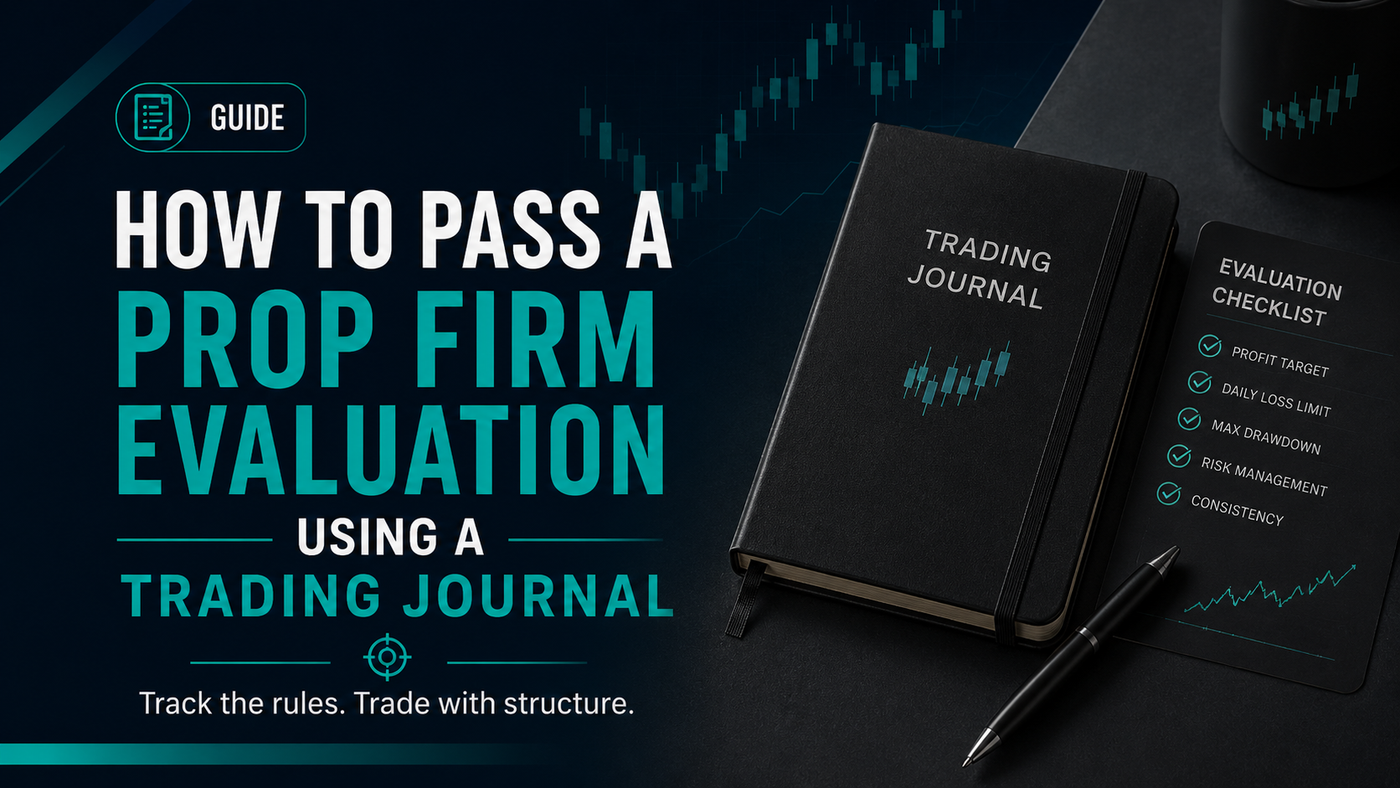
How to Pass a Prop Firm Evaluation Using a Trading Journal
Most traders who fail a prop firm evaluation don't fail because their strategy is broken.
They fail because they can't control themselves. One bad session. One trade taken outside the plan. One revenge entry after a stopped-out morning — and suddenly you're staring at a breached drawdown limit and starting the whole thing again.
I've been there. I failed multiple evaluations before I worked out what was actually going wrong. It wasn't my edge. It was my execution — and more specifically, my inability to see patterns in my own behaviour until it was too late.
That changed when I started treating my trading journal as a serious tool rather than an afterthought.
This guide breaks down exactly how to use a trading journal to pass your prop firm evaluation — whether you're on Topstep, Apex Trader Funding, TopOneFutures, or anywhere else.
Why Most Traders Fail Evaluations (It's Not the Strategy)
Prop firms don't care if you're profitable in the long run. They care if you can follow rules under pressure — right now, this week, this month.
The most common failure points are:
- Breaching the daily drawdown limit after one or two bad trades, then trying to "win it back"
- Overtrading on days when the market isn't giving clean setups
- Ignoring the maximum loss limit because of one catastrophic session
- Trading outside your hours or in low-liquidity conditions out of boredom
Every single one of these is a behaviour problem, not a strategy problem. And behaviour problems are invisible until you document them.
What a Trading Journal Actually Does During an Evaluation
A journal during a prop firm eval isn't about logging your winners. It's about accountability — specifically:
1. It creates friction before bad trades
When you know you have to write down why you took a trade, you pause before taking it. That pause is everything during an evaluation. It's the difference between a calculated entry and an emotional one.
2. It shows you your personal drawdown patterns
Most traders have a "danger zone" — a time of day, a market condition, or an emotional state where they make the trades that blow accounts. You can't see it in real time. You can only see it in your journal, looking back.
3. It keeps your daily loss limit front of mind
Logging your running P&L after every trade is a simple habit that stops you from accidentally wandering towards your daily limit without realising it.
4. It separates good trading from good luck
During an evaluation, you need to know whether your profits came from your edge or from market conditions that happened to suit you. That distinction matters when you move into a funded account and conditions change.
The Exact Journal Setup I Use for Prop Firm Evaluations
You don't need anything complicated. Here's what works:
Pre-Session Section (write this before you trade)
- Today's daily loss limit (firm rule — write it down every single day
- Market bias and why (brief — one or two lines)
- What setups I'm looking for
- What I will NOT trade today (conditions or times to avoid)
- My emotional state out of 10
That last one matters more than traders want to admit. If you're a 4 or below before you sit down, your risk per trade should drop or you shouldn't trade at all.
Per-Trade Section
- Instrument and direction
- Entry price, stop, target
- Why I took the trade (must match your plan)
- Result
- Execution score out of 10 (separate from result — a stopped-out trade can still score 9/10 if you followed the plan)
End of Session Section
- Total P&L
- Running account balance vs drawdown limits
- What worked
- What didn't
- One thing to carry into tomorrow
Tracking the Numbers That Actually Matter During an Eval
Your journal should track these specifically for prop firm evaluations:
| Metric | Why It Matters |
| Daily P&L vs daily loss limit | Never breach the line you can't cross |
| Running total vs max drawdown | Know exactly where you stand every session |
| Win rate by session time | Shows you when you're actually sharp |
| Average R per trade | Tells you if your targets are realistic |
| Trades taken outside plan | The number that gets most accounts blown |
That last column is the one most traders skip. It's also the most important. If you're taking trades outside your plan and still passing, you're getting lucky — and luck runs out.
The Pattern That Gets Most Evaluations Blown
I've talked to a lot of funded traders. The pattern that shows up again and again is this:
You have a great first week. You're up, the account's healthy, you're feeling confident. Then you have one bad morning in week two — maybe down a hundred or a couple hundred. Instead of stopping and walking away, you start adjusting. Taking trades you wouldn't normally take. Widening stops slightly. Adding size.
By lunch, you've breached your daily drawdown and the evaluation is over.
The journal fix for this is simple: set a personal daily stop-loss that's tighter than the firm's limit. If your Tradeify daily limit is $1,000, stop yourself at $600. Write that number in your journal every morning. When you hit it, close the platform.
It sounds basic. But most traders never write it down — and what doesn't get written down doesn't get respected under pressure.
Prop Firm-Specific Things to Track
Different firms have different rules. Your journal should reflect yours.
Topstep — track your trailing max drawdown separately. It moves as you profit, which catches traders off guard.
Apex Trader Funding — multiple account options with different scaling rules. Log which account you're trading and its specific limits at the top of every session.
TopOneFutures — note the consistency rules if applicable. Your journal can help you demonstrate consistent performance rather than one or two outsized days.
Whatever firm you're on, copy their exact rules into the front page of your journal. Read them before you start every session during the evaluation period.
After You Pass: Using Your Eval Journal as a Funded Trader Blueprint
The traders who stay funded long-term are the ones who treat the evaluation journal as a baseline, not a finished product.
Once you pass, review your journal and ask:
- Which days were my best and why?
- What conditions did I avoid that I should keep avoiding?
- Were there any evaluation rules I found helpful that I should keep even though I'm now funded?
The habits you build during an evaluation are the habits that protect your funded account. The journal is what makes those habits visible and repeatable.
Final Thought
Passing a prop firm evaluation is about proving you can trade a rule set consistently under pressure. That's a discipline problem, not a strategy problem.
A physical trading journal — something you write in with your hand, not just a spreadsheet you update when you remember — creates accountability in a way that digital tools often don't. There's something about the act of writing that makes the commitment real.
If you want to see what a structured evaluation journal looks like in practice, the DMC Trading Journal is built specifically for futures traders running prop firm accounts. It's A3, spiral-bound, and designed to be used at the desk — not filed away.
Explore the DMC Trading Journal →
Want this read on your own chart?
Wave Rider marks the structure, the EMA stack and the levels automatically — live, on any market you trade.
See Wave Rider → Or start with the free onesCharting and analysis only — nothing here is financial advice. Trading involves substantial risk of loss.